Showing posts with label meat. Show all posts

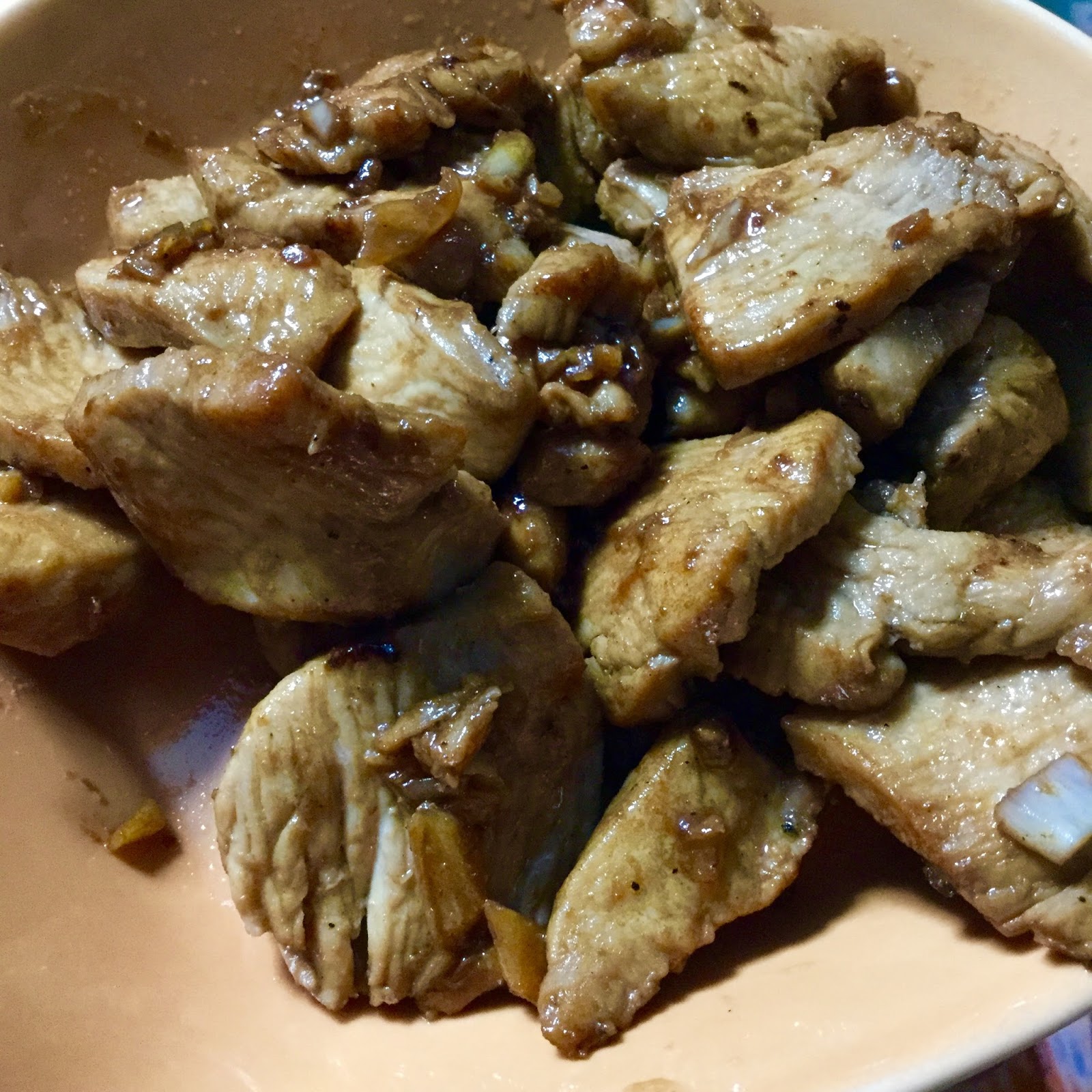
Chicken Salpicao

Chicken breast is the cheapest cut of meat in Japan so I do collect recipes that manage to bring out the best in chicken breasts (i.e. keep them juicy). I grew up associating salpicao with cubes of beef and it is usually an appetizer or pica-pica (finger food to go with beer). For us, this is a main dish that goes with plain rice. 

500 grams chicken breast cut into bite-size pieces

3 cloves garlic for marinating + 3 more for sauteeing
3 T worcestershire sauce
3 T Bragg's Liquid Aminos 
1 T ground black pepper
2 T butter
Button mushrooms sliced (dish is still great without mushrooms)

Marinate chicken in garlic, pepper, worcestershire sauce and Bragg's Liquid Aminos for at least an hour. Heat butter in pan. Saute garlic and mushrooms. Toss in chicken but do not put in all the sauce. The dish might end up too salty. Cook until chicken is done and serve hot. 


Effortless Paella

"Paella is not an easy dish." (quoted from actual recipes)

And I have always thought so too, until I made this up, taking the essentials from various recipes. Paella, for me, should have the following characteristics: 

1. Rice is not soggy. 
2. It has to be yellow. 
3. It's got a distinct cumin-meat-seafood flavor. 
4. There's paprika or bell peppers cooked until nicely soft. 
5. The rice is deliciously browned and caramelized at the bottom.

Thanks to the even cooking of the rice cooker, an essential in every Asian home, you get perfectly cooked rice that is browned at the bottom every single time. Is it authentic Valencian Paellla? Probably not but who cares? We love it. It's an effortless one-pot flavorful dish that I guarantee you'll make again. 


1 cup rice (I used Japanese rice)
½ onion, choped 
2-3 cloves garlic minced
1 red bell pepper/paprika diced (I have also used yellow, orange and green peppers successfully in the past but prefer bright red in my paella
50-100g shrimp and/or scallops
50-100g chicken breast diced
1 chorizo sausage or similar sliced (The closest thing I could find is beer sausage)
1 T olive oil
½ t turmeric powder
½ t cumin
1 t Better than Bouillon soup base + 1 t Bragg's Liquid Aminos (These two are staples in my kitchen and are very versatile but in the event you don't have either, go with chicken broth)
pepper to taste 

Wash the rice. Place rice in the rice cooker with the recommended amount of water or broth if doing chicken broth (follow the line indicated on the pot). Set aside. Heat olive oil in a pan. Saute onions and garlic. Add paprika, shrimp and/or scallops, sausage, and chicken. Turn off heat when chicken turns white but not fully cooked. Pour everything into the rice cooker. Add the turmeric, cumin, black pepper, the Better than Bouillon soup base and Bragg's Liquid Aminos. Stir to gently mix. Press the cook button on your rice cooker. That's it!


Club Bistek

When I was a child, my family had a membership at a sports club. Almost every afternoon in the summer, my sisters and I would swim at the club's pool. The pool was near the lounge and every now and then, mouthwatering smells from the lounge's restaurant would waft to the pool area and one of their specialties is "Bistek Tagalog" (Tagalog Beef Steak). I believe our nose has its own memory because every time I smell the distinctly wonderful smell of onions and garlic in butter, I can also almost smell the chlorine of the swimming pool and I am transported back to the happy days of my childhood. This recipe is an attempt to recreate that wonderfully savoury dish, Bistek Tagalog which the club restaurant serves in a sizzling plate. For bistek, calamansi is usually used, a citrus local to the Philippines. Since it's almost impossible to find calamansi in Japan, I substituted lemon which can be found in any supermarket.  I am also partial to using the nice thin slices of pork as my kids find that easier to eat than beef or even pork chop slices. Soy sauce is crucial to this dish. It is essential for marinating the meat and it gives the meat and the onions a beautiful caramel color. 


3 cloves garlic chopped finely
ground black pepper
1-2 T fresh lemon juice
3-4 T soy sauce
300 g thinly sliced pork (or beef if preferred)
1 large onion sliced into ring
1 T butter (or olive oil if preferred)

Mix the garlic, ground black pepper, lemon juice and soy sauce in a bowl. Marinate the thinly sliced pork in this mixture for at least 30 minutes. In a frying pan, heat the butter or oil on medium high and pan fry the onions until soft. Move to the side of the pan. Pan fry the pork pieces until done but do not overcook. Serve hot with rice.


Southern Fried Chicken Karaage

Every book I've read set in the American South almost always has Southern Fried Chicken in it. I'm gastronomically curious as to how different this is from the fried chickens I've ever had. Someone passed on to me Amy Sedaris' I like you: Hospitality under the influence and saw how ridiculously simple her recipe is. Unfortunately, I don't have the buttermilk and lard that her recipe called for so I substituted yoghurt for buttermilk and just plain cooking oil for frying. I also used chicken breast and cut them into bite-sized pieces much like your regular Japanese karaage. The results were outstanding. My husband who used to be stationed at South Carolina declared this to be as good as he remembered. He requested this for his birthday.   

Chicken breast, cut into bite size pieces
yoghurt
paprika
salt
pepper
cornstarch and flour (1:1 ratio)
oil for frying

Marinate chicken pieces in yoghurt, paprika, salt and pepper overnight. Dredge in the cornstarch-flour mix. Deep fry until done. Serve hot.


I Swear It's Not Store Bought Niku Jaga

Niku jaga (braised meat and vegetables) is to the Japanese as adobo is to Filipinos. It is a good hearty fare that reminds one of home. This is one of the easiest Japanese dishes to cook and it's a great one-pot dish that's got protein and veggies in it. I once invited a friend to come over for a simple dinner of niku jaga and rice. She insisted that my niku jaga must have been store bought. She has placed an order for a huge batch that she can reheat at home.

1 T oil
250 g beef or pork thinly sliced
1 onion sliced into rings
2 potatoes, cut into wedges
2 carrots, cut into wedges
1 pack of ito-konnyaku or shirataki, boiled in water then rinsed
1¼ cup water
3 T sugar
2 T sake
3 T soy sauce
1 T mirin

Heat oil in a pot and fry up the meat. Add the ito-konnyaku or shirataki, onions, potatoes and carrots. Add water and bring to a boil. Reduce heat and add sugar and sake. Simmer for another 5 minutes. Add soy sauce and mirin. Simmer until all the liquid is gone. Serve with seven spice.


Un-Mapo Tofu

Growing up, a visit to a Chinese restaurant was not complete without an order of mabo tofu, one of my dad's favorites. Originally from Sichuan, this dish is typically so spicy we would order it with a request to make it "mild." When the dish arrived, my dad would add chili peppers to his portion and work up a good sweat. My kids, including my one year old, can tolerate a small amount of spicy doubanjiang. Adjust it according to your taste.

Seasoning ingredients:

a knob of grated ginger

1-2 cloves of garlic, minced or crushed

1 tsp spicy doubanjiang

1 tsp additive free chicken stock granules

1 Tbsp sake

1 tsp sugar

1 and 1/2 Tbsp soy sauce

sesame oil for sautéing

100 grams ground meat (pork or chicken works)


1 tray of silken (called kinu in Japanese) tofu, cut into small cubes 

chopped spring onions for garnish


(if needed) a small amount of starch mixture made from water and potato starch or corn starch (this is to thicken the sauce at the end)


Prepare and mix the seasoning ingredients in a small bowl. Set aside. Sauté the ground meat in sesame oil. Pour in the seasoning. Heat through and add water if necessary. Toss in the cubed tofu and work carefully so as not to break it up too much. If there’s too much water in the dish, thicken the sauce with the starch mixture. Remove from heat and top with spring onions. Best served over a bowl of steaming plain rice.